The long-run return figure for Tower Rush is not a promise and it is not a plan. Tower Rush is built by Galaxsys and sits inside its Fast Games and Turbo Games portfolio, and the studio publishes an RTP range of 96.2% to 97.6% for the game. Our job here is to take that band apart: to show what it measures, what the remaining house edge does across millions of rounds, and which claims about guaranteed returns collapse the moment the arithmetic is done honestly.
Every number below is a long-run theoretical figure. None of it describes the next round, and none of it can be steered. That is the single most important idea in our Tower Rush coverage.
Tower Rush RTP: What the Figure Actually Measures
The RTP of Tower Rush is the share of all money staked that the game is designed to return over an extremely long run, measured in millions of rounds. It is a design constant of the maths, not a live counter and not a target that a session is expected to hit. A band of 96.2% to 97.6% means that, across a very large sample, the total returned across the game is expected to fall in that range.
What it does not do is describe the next round. Every individual Tower Rush round ends in one of two ways: a cash-out at the cumulative multiplier reached, or a collapse that ends the round and loses the active stake. The RTP has nothing to say about which of those two outcomes arrives. It is a statement about the shape of the whole distribution, not about a single point inside it.
That distinction is what separates a useful RTP explanation from a misleading one. A figure that is accurate about a million rounds can be completely silent about the next sixty seconds, and both things are true at once.
Tower Rush RTP 96.2% to 97.6%: Why We Report a Range
We report a range because Galaxsys publishes a range. The settlement configuration of Tower Rush can vary between versions and between settings, so the studio reports a band rather than a single figure. The bottom of that band, 96.2%, and the top, 97.6%, are two honest settings of the same game, not a typo and not a marketing split.
The practical consequence is simple. Any page that names one precise Tower Rush RTP and presents it as the only true value is overstating what is known. We will not do that. The published band is what the studio states, and our coverage stays inside it.
If a specific figure matters, the game information panel on the active build is the only place that can confirm it for that build. Anything more precise than the published band is guesswork dressed as data.
Galaxsys states 96.2% to 97.6%. We repeat that band and never invent a narrower one.
Tower Rush House Edge: The Other Side of the Percentage
The house edge is simply 100% minus the RTP. At the 96.2% end of the Tower Rush band, the edge is 3.8%. At the 97.6% end, it is 2.4%. One of those two figures is always present in the maths; the question is only which end of the band the active configuration sits at.
The edge is not a fee taken out of each round in a visible way. It is baked into the floor odds themselves. Each floor offers a return that, across the whole game and across millions of attempts, leaves a small margin behind. There is no moment where a deduction appears on screen, because the deduction is inside the price of each step.
Reading the edge correctly matters more than reading the RTP. A 3.8% edge and a 2.4% edge are both edges; both grind in the same direction over a long enough run. A smaller edge is cheaper entertainment, not a different kind of game.
Tower Rush House Edge Per Floor and the Compounded Arithmetic
Every successful floor multiplies the cumulative value of a round rather than adding to it. That is what makes a tall tower worth so much and also what makes it so unlikely. The table below shows the arithmetic of compounding using an illustrative per-floor value, purely to demonstrate how the multiplication stacks up. It is not a Tower Rush paytable, and it is not drawn from Galaxsys data, because the studio does not publish individual floor odds.
| Floors built | Illustrative per-floor value | Cumulative multiplier (multiplied) | What the rule implies |
|---|---|---|---|
| 1 | 1.20x | 1.20x | The value of a single successful floor |
| 2 | 1.20x | 1.44x | Each new floor multiplies the last total |
| 3 | 1.20x | 1.73x | Growth accelerates as the tower rises |
| 4 | 1.20x | 2.07x | Doubling arrives somewhere between floors four and five |
| 5 | 1.20x | 2.49x | The chance of reaching this floor keeps shrinking |
| 6 | 1.20x | 2.99x | Compounding pays for height in probability |
| 7 | 1.20x | 3.58x | A taller tower is rarer, not merely larger |
| 8 | 1.20x | 4.30x | The same rule continues with no fixed ceiling |
The same arithmetic, read in reverse, explains the house edge. A fair price for a given chance would be the exact inverse of that chance, and the published 96.2% to 97.6% band means the offered values sit, on average, between 2.4% and 3.8% below that fair line. Nothing about changing floor count, stake or rhythm moves that line. It is part of the game, not part of a decision.
Tower Rush Max Multiplier and the Limits of a Limitless Tower
Galaxsys describes the tower in Tower Rush as limitless, and the potential floor count as effectively open. That means there is no published maximum multiplier. We will not invent one. What we can say is that growth by multiplication has a natural brake that has nothing to do with a cap: the more floors a run requires, the smaller the chance that the run survives that far.
So the practical ceiling on a Tower Rush round is probabilistic, not mechanical. A very tall tower is possible in the same sense that a long run of coin flips is possible. It is not forbidden; it is simply rare, and it gets rarer with every extra floor. Any figure claiming a fixed maximum multiplier for Tower Rush is a number that the studio has not published.
Tower Rush Odds and Volatility: Why Session Length Matters
Volatility and RTP answer two different questions. RTP says how much returns over a very long run. Volatility says how violently the results swing on the way there. Tower Rush plays like a fast, high-volatility game, because the outcome of a round is decided by how far the tower rises before it ends.
In a high-volatility game, most rounds finish at a low floor and a small number of rounds reach a tall tower. That shape produces long quiet stretches and occasional large results. Two games with the same RTP band can feel completely different, because the same long-run return can be delivered in very different patterns.
Volatility is why session length matters to how a run feels, even though it changes nothing about the maths. A short session samples a tiny slice of the distribution, and that slice can look far better or far worse than the theoretical figure. Neither outcome is evidence about the RTP.
Tower Rush Bonus Floors and Their Effect on the Maths
Tower Rush includes bonus floors, and Galaxsys names them: the Frozen Floor, the Temple Floor and the Triple Build. These are features of the tower and part of what separates the game from a plain stacking loop. They change the pattern of floors and values inside a round.
What they do not do is change the published RTP band. The 96.2% to 97.6% figure already accounts for every feature the game contains, including the bonus floors. A bonus floor is not a separate game with its own return; it is part of a round whose overall return is already inside the published band.
We describe bonus floors as features and do not attach invented values to them. Their effect on the maths is already included in the number Galaxsys publishes, and nothing here should be read as a promise that a bonus floor appears on a schedule.
Tower Rush Provably Fair: How a Round Can Be Verified
Tower Rush uses Provable Fairness with RNG technology. The idea behind provable fairness is that a round can be checked after the fact rather than trusted on faith. Depending on the active build, a fairness interface may show a round identifier, a hash, seed-related information, a nonce or a verification control.
The verification works in principle the same way it does in other provably fair games: a commitment is shown before a round, and the material needed to test it is revealed after the round, so that anyone can recompute the result and confirm the round was not altered. That is what verification proves. It does not raise the RTP, it does not predict a future round and it does not turn the game into a skill test.
Provable fairness and RTP are complementary facts, not competitors. One says the result was not tampered with. The other says what the long-run return of the whole game is. Both can be true, and neither is a plan.
Tower Rush Payout: What a Return Looks Like Across Many Rounds
A Tower Rush payout is the stake multiplied by the cumulative multiplier at the moment of a cash-out. That is the round-level view. The page-level view, the RTP, is different: it is the total returned across millions of rounds as a share of the total staked, and it is designed to fall in the 96.2% to 97.6% band.
Neither view is a guaranteed return. A payout belongs to a round that already happened; an RTP describes a distribution that only resolves over an enormous sample. Holding both ideas at once is the whole discipline of reading the game honestly.
It also explains why a lucky session proves nothing. A short stretch of cash-outs, however generous, is a sample too small to say anything about the band, and a short stretch of collapses is equally uninformative. The figure is a property of the game, not of a session.
Tower Rush RTP and Session Length: The Variance Trap
The RTP of Tower Rush only becomes visible over millions of rounds. A session is a few hundred at most. That gap is where most confusion lives, because a small sample is dominated by variance rather than by the theoretical figure.
It is entirely normal for a short session to return far more or far less than the band suggests. That is not the game behaving strangely and it is not the RTP being wrong. It is what a high-volatility distribution looks like when a tiny slice is examined up close. The band describes the whole picture, and a session is one small corner of it.
Because of that, treating RTP as a schedule for a single sitting is the core mistake. The number is honest about the long run and deliberately silent about the short one, and no amount of stake adjustment changes which of those two things a session is.
Comparing the Tower Rush 96.2% and 97.6% Configurations
The two ends of the published band differ by an edge that looks small in isolation. Laid side by side across a theoretical sample, the difference is easy to read. The figures below are derived directly from the published band and are theoretical long-run values, not guarantees and not a payout table.
| Measure | 96.2% setting | 97.6% setting |
|---|---|---|
| Published Tower Rush RTP | 96.2% | 97.6% |
| House edge | 3.8% | 2.4% |
| Theoretical return per 1,000 units staked | 962 units | 976 units |
| Theoretical margin retained per 1,000 units staked | 38 units | 24 units |
| Which setting applies | Whatever the game information panel on the active build states | |
| Effect on the next round | None. Both ends are silent about a single round | |
| Effect of a strategy | None. No stake pattern moves either figure | |
The comparison shows what a higher RTP really means: a slightly smaller long-run cost, not a higher chance of a profit. A 2.4% edge and a 3.8% edge are cousins, not opposites. Both are edges, and both apply to every staked unit.
Tower Rush RTP Misunderstandings We See Most Often
A handful of wrong readings account for most of the confusion about the Tower Rush RTP. Each one fails for a simple reason.
- RTP as a win rate. The band is a long-run return, not the share of rounds that end in a cash-out. A high RTP does not mean frequent wins.
- A high RTP as a guarantee. The figure only resolves over millions of rounds. A single session can land anywhere.
- Stake size changing the RTP. The maths is fixed. Bigger or smaller stakes change the variance, not the return percentage.
- The range as a hidden best case. Both ends are real settings, and neither is a special advantage unlocked by a platform.
- RTP resetting after a loss. There is nothing to reset. The figure is a property of the game, not a running balance.
- A payout table for Tower Rush. No such table is published by Galaxsys, so any exact one circulating is invented.
Why a High Tower Rush RTP Is Not a Plan
A high RTP is a smaller cost of play over a long run, and that is the entire benefit. It is not a plan, because a plan implies an edge, and the edge against the stake in Tower Rush is negative at both ends of the published band. A 97.6% return still leaves 2.4% behind across the long run; a 96.2% return leaves 3.8%.
That is why leaning on a favourable RTP to chase a result is a losing structure by design. The maths does not reward patience and it does not punish impatience; it simply applies the same edge to every staked unit until the long run asserts itself. A high RTP makes play cheaper and slower, not profitable.
The only honest reason to prefer a higher RTP is that entertainment costs less over time. That is a real advantage and it is worth having. It is also a long way from a method.
Where Our Tower Rush Figures Come From
Every figure in our Tower Rush coverage traces back to the published band Galaxsys states for Tower Rush, 96.2% to 97.6%, plus the arithmetic that follows from it. We derive the house edge of 3.8% and 2.4% by subtracting each end from 100%. We derive the per-1,000 theoretical returns by applying each end to a sample stake. Nothing is invented, and no narrower figure is presented as if it were published.
We test the game in demo mode and in a mobile browser, and we check the fairness panel, the bonus-floor names and the game information panel against provider material. Where the studio has not published something, such as individual floor odds or a maximum multiplier, we say so plainly instead of filling the gap.
For a hands-on walkthrough of the controls, our Tower Rush how to play guide covers the build and cash-out loop stage by stage, and the Tower Rush demo online page shows how free virtual credits behave with no monetary stake. Payment and app questions belong on the Tower Rush download page, and short answers on a wide range of topics sit in our Tower Rush FAQs.
Tower Rush RTP and Predictor Claims: Why Signals Cannot Work
Predictor apps, signal sellers and hacks share one premise: that the next floor can be known in advance. That premise is false. Tower Rush results are decided by server-side RNG, and the material that produces a result is generated on the server, not on the device. An external app cannot read entropy it never receives.
A predictor that claims a hit rate is either guessing, editing its own history, or both. If it genuinely worked, it would not need to be sold to strangers at a price. The same logic applies to any strategy marketed as raising the RTP of Tower Rush, because no such lever exists inside the maths.
Anyone promising a guaranteed Tower Rush result is selling something that cannot exist. Our coverage never endorses predictor tools.
Tower Rush RTP and Responsible Play
Reading the maths properly leads to a simple conclusion: Tower Rush is a game of chance funded from an entertainment budget. A high RTP does not change that, and no session should be funded by money set aside for anything else. Limits for a deposit, a loss and time, fixed before a session, keep the cost inside budget.
Chasing a loss is where an entertainment cost turns into damage, because the edge applies to every unit staked, however determined the intent. Stepping away is always the stronger move. Anyone in India who needs support can contact the KIRAN helpline, which is free and available around the clock.
18+ only. Tower Rush is a game of chance, never income. A limit fixed before a session is the only control that works from the first round.
Tower Rush RTP FAQs
What is the Tower Rush RTP?
Galaxsys publishes a Tower Rush RTP range of 96.2% to 97.6%. It is a long-run theoretical figure measured across millions of rounds, and it says nothing about the outcome of the next round.
Why is the Tower Rush RTP a range rather than one number?
The settlement configuration can vary between versions and settings, so the studio reports a band instead of a single figure. Both ends are honest values, and neither is a promise for a session.
What is the Tower Rush house edge?
The house edge is 100% minus the RTP, so it is 3.8% at the 96.2% end and 2.4% at the 97.6% end. It is a theoretical long-run margin, not a fee deducted from every round.
Can any strategy raise the Tower Rush RTP?
No. RTP is fixed inside the Tower Rush maths, and no stake pattern, floor count or cash-out routine changes it. Every staked unit carries the same edge.
Does Tower Rush have a maximum multiplier?
Galaxsys describes the tower as limitless, so there is no published cap on the cumulative multiplier. Growth is bounded in practice by the chance of a collapse, not by a fixed ceiling.
Is Tower Rush provably fair?
Tower Rush uses Galaxsys Provable Fairness with RNG technology. Verification confirms that a round was not altered after the fact, and it does not change the RTP or predict a future round.
Do Tower Rush predictor apps work?
No. Tower Rush outcomes are decided by server-side RNG, so no external app or signal can read the next floor. Any tool that sells a guaranteed result is selling something that cannot exist.
What is Tower Rush volatility?
Volatility describes how widely results swing around the RTP. Tower Rush plays like a fast, high-volatility game, where many rounds end early and rare runs build a tall tower.
Tower Rush RTP: A Final Note
The Tower Rush RTP band of 96.2% to 97.6% is a long-run statement about the whole game, published by Galaxsys and confirmed by nobody's session. It describes what millions of rounds return in aggregate and says nothing about the next floor. The house edge behind it, 2.4% to 3.8%, applies to every staked unit and yields to no strategy, no stake pattern and no predictor app.
Held correctly, that is a useful way to read Tower Rush: a fast, high-volatility game where a higher RTP means a cheaper cost of play, not a route to profit. Everything else in our Tower Rush coverage is detail around that idea, and the detail is there precisely because the honest version of the maths is more useful than the flattering one.
18+ only. Tower Rush is a game of chance, not income. India helpline (KIRAN, 24x7): 1800-599-0019.
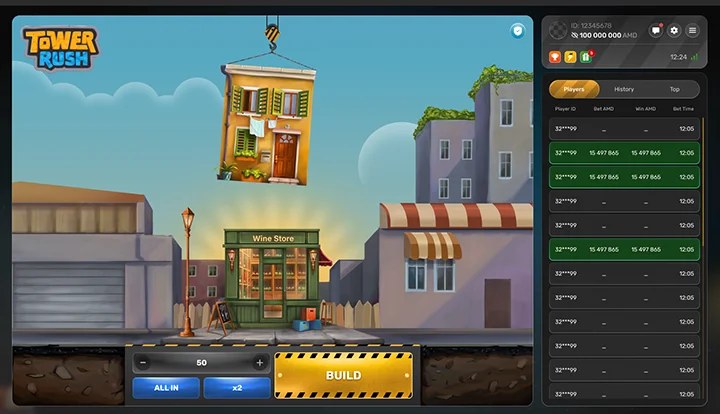
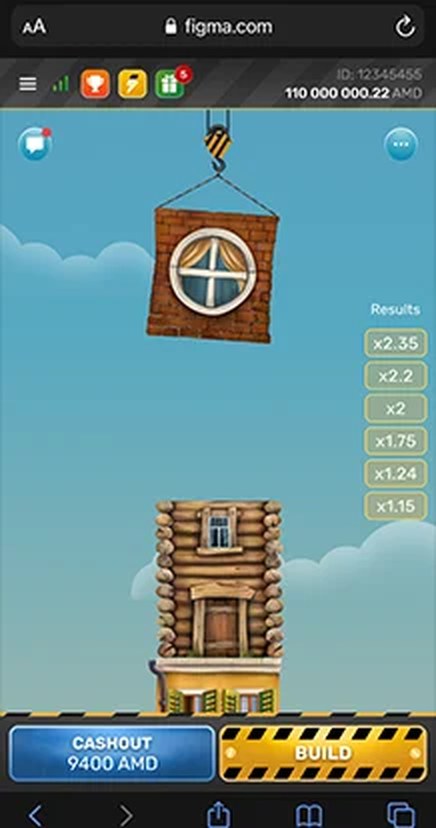
Tower Rush Game Screens
Real Tower Rush captures from our platform review, so every visual in our coverage shows the actual Galaxsys product rather than a redrawn mock-up.